Infostealers infected 23M+ devices in 2024, stealing 2.1B credentials. Learn how RedLine, Lumma, Raccoon and Vidar work.
What Are Infostealers and Why They're More Dangerous Than Data Breaches
In 2024, infostealer malware silently infected over 23 million devices worldwide and stole 2.1 billion credentials. Unlike data breaches that make headlines, infostealers operate in the shadows — harvesting everything from your saved passwords to banking details in under 60 seconds. And here is the critical part: changing your password after an infostealer attack does almost nothing to protect you.
This article explains what infostealers are, how they differ from traditional data breaches, which malware families dominate the threat landscape, and what you can actually do to protect yourself.
What Is Infostealer Malware?
An infostealer (information stealer) is a category of malware specifically designed to extract sensitive data from an infected device and transmit it to an attacker-controlled server. Unlike ransomware, which announces its presence with encrypted files and ransom notes, infostealers are built to be invisible. The entire operation — from infection to data exfiltration — typically completes in under 60 seconds.
Once executed, an infostealer systematically harvests:
- Saved passwords from all installed browsers (Chrome, Firefox, Edge, Opera)
- Session cookies and tokens — allowing attackers to hijack active sessions without needing passwords at all
- Autofill data including names, addresses, phone numbers
- Credit card numbers stored in browser payment managers
- Cryptocurrency wallet files (Exodus, MetaMask, Phantom, Atomic)
- Two-factor authentication tokens and authenticator app data
- VPN and FTP credentials
- Desktop files, screenshots, and clipboard contents
Modern browsers encrypt stored credentials, but the encryption keys are accessible to any process running under the user's privileges. Infostealers simply decrypt the credential database, package the data into a "log," and upload it — all before the victim has any idea something happened.
The Big Four: Dominant Infostealer Families
RedLine Stealer
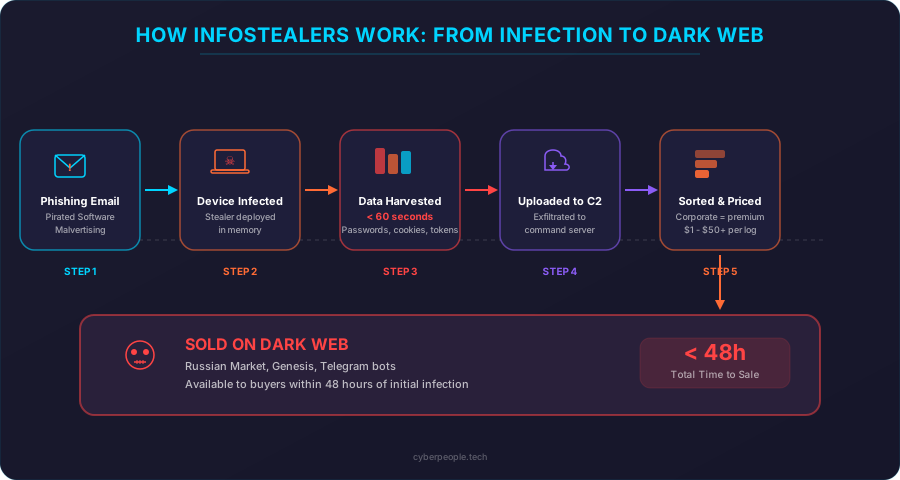
First identified in March 2020, RedLine became the most prolific infostealer in history. According to Kaspersky research, RedLine was responsible for 51% of all infostealer infections between 2020 and 2023. Flashpoint's 2025 report found that RedLine infected 9.9 million hosts in 2024 alone — 43% of all observed infostealer infections that year. In October 2024, Operation Magnus — a joint effort by Dutch National Police, the FBI, and partner agencies — disrupted RedLine's infrastructure, but the malware's codebase continues to circulate among cybercriminals.
Lumma Stealer (LummaC2)
Lumma surged from under 1% market share in 2023 to 31% in 2024, becoming the single most prevalent infostealer. ESET reported a 369% increase in Lumma detections between the first and second halves of 2024. By Q4 2024, Lumma accounted for nearly 92% of credential log alerts on Russian Market, the largest dark web marketplace for stolen credentials. In May 2025, Microsoft's Digital Crimes Unit led a global disruption, seizing approximately 2,300 malicious domains in coordination with Europol and the FBI. The takedown was partially effective — new command-and-control infrastructure appeared within weeks.
Raccoon Stealer
Raccoon has been a consistent presence in the infostealer ecosystem, with operators managing over 50 million compromises. It targets an exceptionally wide range of data: credentials, cookies, credit cards, crypto wallets, plus data from password managers (Bitwarden, 1Password), email clients, and messaging apps including Telegram, Signal, and Discord. Despite the arrest and sentencing of a key operator in 2022-2024, Raccoon's affiliate model keeps it operational. KELA's 2025 report identifies Raccoon2 as one of the top three infostealers, responsible alongside Lumma and RedLine for 85% of all infections.
Vidar Stealer
Vidar was the second most common infostealer in the second half of 2024, appearing in 17% of all cases and stealing more than 65 million passwords. Its distinguishing feature is a self-destruction capability — after harvesting data, it removes itself from the system, significantly reducing the chances of forensic detection. In October 2025, Vidar 2.0 was released — completely rewritten in C with enhanced stealth, efficiency, and expanded data collection capabilities.
How Infostealers Spread
Infostealers reach victims through three primary vectors:
1. Phishing and Social Engineering
Targeted emails containing malicious attachments disguised as invoices, shipping notifications, or job offers. In 2024-2025, a particularly effective variant emerged: ClickFix attacks using fake CAPTCHA pages that trick users into executing malicious commands while believing they are completing a human verification check.
2. Pirated Software and Cracked Games
Torrents, warez sites, and fake "crack" downloads are among the most common infection vectors. The irony is stark: users downloading pirated software to save money often end up losing far more when their banking credentials, crypto wallets, and corporate VPN access are stolen and sold.
3. Malvertising and SEO Poisoning
Attackers purchase advertising space on legitimate platforms (including Google Ads) to redirect users to fake software download pages. SEO poisoning places malicious sites at the top of search results for popular software queries. Users searching for tools like OBS Studio, Slack, or Zoom may click on promoted results that deliver infostealer payloads instead of legitimate software.
From Infection to Dark Web Sale: The 48-Hour Pipeline
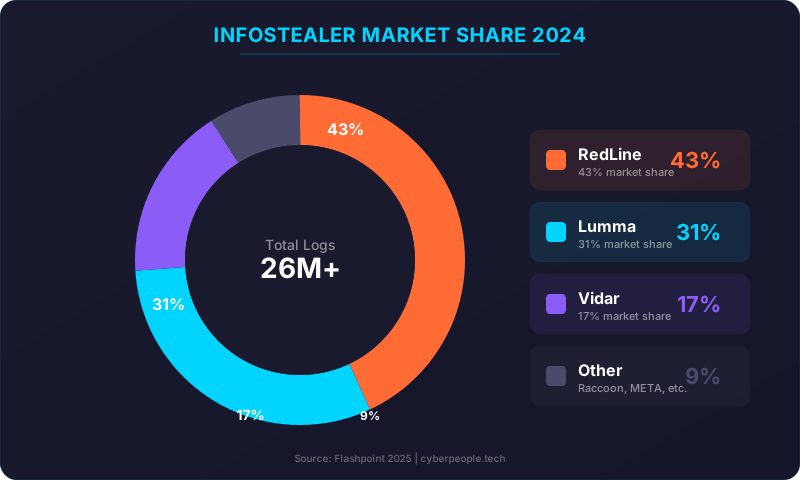
Research published in 2026 by Whiteintel's Intelligence Division mapped the precise timeline from infection to marketplace sale:
- Minute 0-1: Malware executes, harvests all browser data, cookies, files, crypto wallets, and system information
- Minute 1-5: Data packaged into a "log" and uploaded to attacker's command-and-control server
- Hours 1-24: Logs sorted, categorized, and priced based on value (corporate credentials, banking access, and crypto wallets command premium prices)
- Hours 24-48: Logs listed for sale on dark web marketplaces like Russian Market, Genesis Market successors, and Telegram channels
- Hours 48+: Buyers use credentials for account takeover, corporate network infiltration, or ransomware deployment
The scale is staggering. Constella's 2026 Identity Breach Report processed 51.7 million credential packages in 2025 alone — a 72% year-over-year increase. Individual logs sell for as little as $2-10, while logs containing corporate VPN or cloud service credentials can fetch hundreds of dollars.
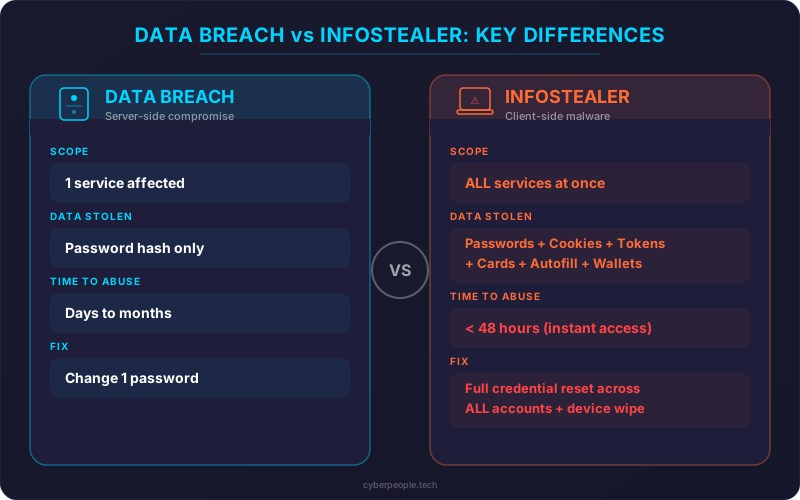
Data Breach vs. Infostealer: Why the Difference Matters
| Characteristic | Traditional Data Breach | Infostealer Infection |
|---|---|---|
| Attack target | Company server or database | Individual device (your PC or laptop) |
| Data compromised | Email + hashed password for one service | ALL saved passwords, cookies, tokens, cards, files across ALL services |
| Session tokens | Not typically exposed | Stolen — attackers can bypass 2FA entirely |
| Scope of damage | Limited to the breached service | Every account saved in the browser |
| Does changing password help? | Yes — new password secures the account | Partially — stolen cookies and tokens remain valid until they expire |
| Detection | Company notifies affected users | Victim usually has no idea they are compromised |
| Time to exploitation | Days to months | Under 48 hours from infection to dark web sale |
| Connection to ransomware | Indirect | Direct — 54% of ransomware victims had credentials in stealer logs before the attack |
| Cost per credential | Bulk dumps, pennies each | $2-10 per log, $100+ for corporate access |
Why Changing Your Password Is Not Enough
After a traditional data breach, the standard advice is simple: change your password for the affected service. This works because a breach typically exposes a hashed password for a single platform.
Infostealers break this model completely. Here is why:
- All passwords are compromised simultaneously. An infostealer does not grab one password — it grabs every credential saved in your browser. Changing one password while leaving 200 others unchanged accomplishes very little.
- Session tokens bypass passwords entirely. Stolen cookies and session tokens allow attackers to access your accounts without ever entering a password. Even with a new password in place, a valid session token grants full access until it expires.
- The malware may still be active. If the infostealer or its loader remains on the device, any new passwords you enter will be captured immediately. You are feeding fresh credentials directly to the attacker.
- Autofill data cannot be "changed." Your name, address, phone number, and credit card details stored in browser autofill are now permanently in the attacker's possession.
The correct response to an infostealer infection requires a fundamentally different approach: full device scan and potential reinstall, invalidation of all active sessions across every service, rotation of every single credential, and review of all financial accounts for unauthorized activity.
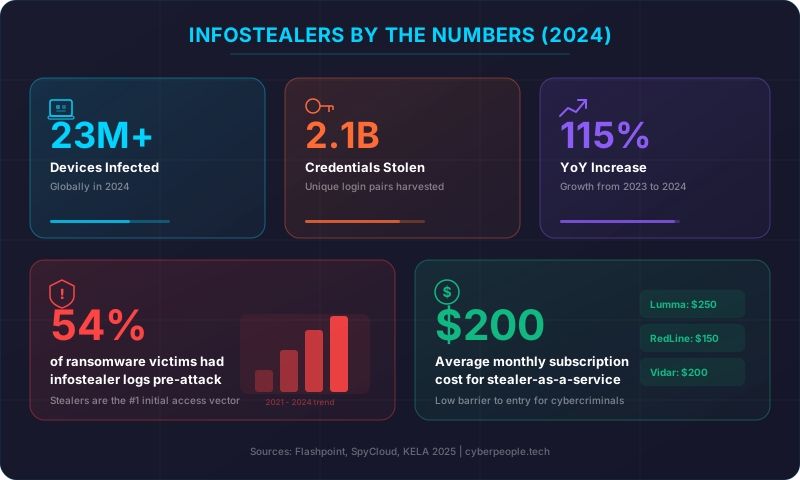
The Numbers Tell the Story
- 3.9 billion credentials stolen by infostealers from 4.3 million devices in 2024 (Kaspersky)
- 2.1 billion credentials harvested by infostealers, representing 75% of all stolen credentials in 2024 (Flashpoint)
- 115% increase in infostealer infections from 2023 to 2024
- 369% surge in Lumma Stealer detections in H2 2024 vs H1 2024 (ESET)
- 670% growth in stealer logs on Russian Market between 2021-2023
- 54% of ransomware victims had domain credentials in infostealer logs before the attack (Verizon DBIR)
- 24% of all cyber incidents in 2024 were traced to infostealers (Huntress)
- $200/month — average cost of an infostealer subscription, making it accessible to virtually any attacker
What You Should Do Right Now
Infostealers are not a theoretical threat — they are the single largest driver of credential theft in 2025. The Malware-as-a-Service model means that any aspiring cybercriminal can deploy a sophisticated infostealer for the cost of a streaming subscription.
Practical steps to protect yourself:
- Stop saving passwords in your browser. Use a dedicated password manager that stores credentials in an encrypted vault separate from your browser.
- Enable hardware-based 2FA (FIDO2/WebAuthn security keys) wherever possible. Software-based 2FA can be intercepted by infostealers; hardware keys cannot.
- Never download pirated software. Cracked software is the single most common infostealer delivery mechanism for consumers.
- Verify download sources. Always navigate directly to the official website of software you want to install. Do not trust promoted search results or ads.
- Monitor for compromise. Regularly check whether your credentials or device data have appeared in stealer log databases.
Check if your device is infected — free
Use our breach check tool to find out if your credentials have been found in infostealer logs or data breaches. Early detection is the difference between a minor inconvenience and a catastrophic compromise of your digital life.